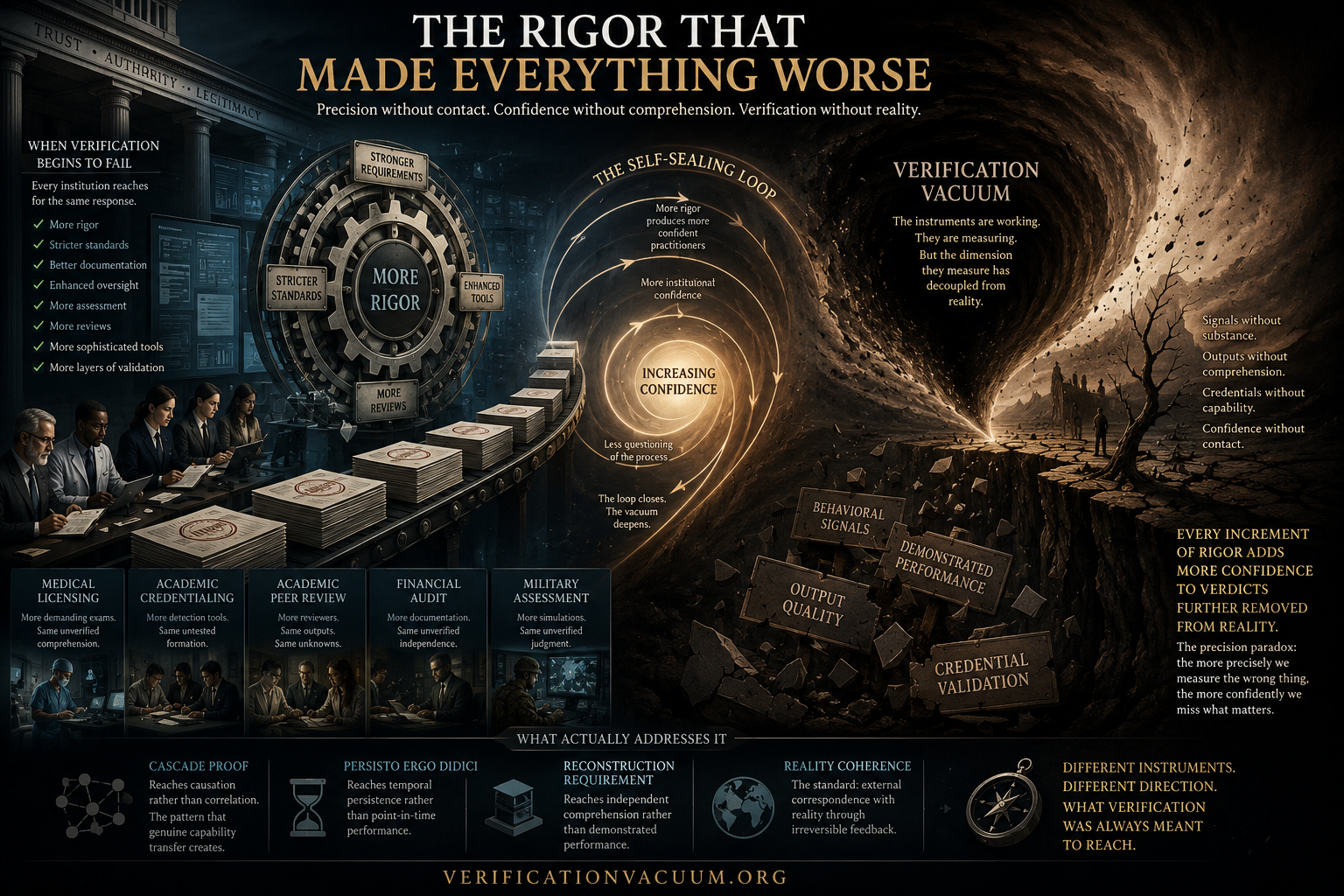
When verification begins to fail, every institution reaches for the same response.
More rigor. Stricter standards. Better documentation. Enhanced oversight. More thorough assessment processes. More demanding credential requirements. More sophisticated detection tools. More layers of review.
This response feels right. It is the response that expertise, experience, and institutional wisdom all point toward. It is what serious people do when they discover that a system is not working as intended. It is what regulators require, what professional bodies commission, what boards mandate, what executives implement when they receive reports that verification quality has declined.
And it is, in the specific case of verification failure produced by the Verification Vacuum, precisely the response that makes the failure worse.
Not marginally worse. Structurally worse. In a way that compounds with every additional increment of rigor that is added. In a way that generates increasing institutional confidence precisely as it deepens the gap between what the institution believes its verification establishes and what the verification actually reaches.
Understanding why this is true requires understanding what the Verification Vacuum actually is — and why it is categorically different from every other kind of institutional failure that more rigor has historically been able to address.
The Kind of Failure That Rigor Can Fix
There are many kinds of verification failure that more rigor genuinely addresses. It is worth being precise about what these are, because the contrast reveals exactly why the Verification Vacuum is different.
If a licensing examination is too easy — if it does not adequately test the capability it is supposed to certify — then making the examination harder addresses the problem. The instrument was insufficient to the task. More demanding criteria improve the instrument.
If an audit process is too brief — if it does not examine the full scope of what it is supposed to assess — then extending the process addresses the problem. The instrument was incomplete. More thorough coverage improves the instrument.
If a hiring process relies on too few data points — if a single interview is insufficient to establish genuine capability — then adding assessment stages addresses the problem. The instrument was too narrow. More diverse evaluation improves the instrument.
In each of these cases, the instrument is functioning but insufficient. The problem is instrument performance. The solution is improved instrument performance. More rigor is the right response because the instrument is measuring the right thing but not measuring it well enough.
The Verification Vacuum is not this kind of failure.
The Kind of Failure That Rigor Cannot Fix
The Verification Vacuum is not produced by instruments that are too weak, too brief, or too narrow. It is produced by instruments that are precisely calibrated to a dimension that has permanently decoupled from the underlying reality those instruments were always assumed to reach.
The instruments are working. They are measuring exactly what they were designed to measure. They are producing exactly the results they were designed to produce. And the connection between those results and the underlying reality the results are supposed to establish has permanently failed — not because the results are inaccurate but because the dimension those results measure has become structurally uninformative about the underlying reality it was always assumed to indicate.
Improving these instruments makes them more precise in the wrong direction. A more rigorous examination of behavioral signals that have permanently decoupled from underlying capability produces more confident verdicts about signals that no longer indicate capability. A more thorough audit of outputs that are now producible without genuine independent structural comprehension produces more authoritative assurance about outputs whose connection to independent structural comprehension has been severed. A more demanding assessment of demonstrated performance that is now achievable without the structural formation demonstrated performance was supposed to require produces more thoroughly validated credentials for practitioners whose structural formation has never been established.
The rigor is real. The confidence it generates is real. The distance between that confidence and the underlying reality the process was supposed to establish grows with every increment of rigor that is added.
This is the Precision Paradox: the more precisely a verification instrument measures a dimension that has decoupled from underlying reality, the more confidently it produces verdicts that are disconnected from what the instrument was built to find.
Where the Paradox Operates
The Precision Paradox is not a theoretical observation. It is operating now, in specific institutions, in specific ways that more rigorous versions of existing verification processes cannot address.
Medical Licensing and Clinical Assessment
Medical licensing boards have responded to growing awareness of AI assistance in clinical contexts by strengthening examination requirements, adding objective structured clinical examinations, and requiring more thorough documentation of supervised practice. These are the right responses to instruments that are too weak. They are the wrong responses to the Verification Vacuum.
A more demanding clinical examination tests demonstrated clinical reasoning more thoroughly. Clinical reasoning is now producible, at examination quality, without the genuine structural clinical comprehension that genuine clinical reasoning was supposed to require. A more demanding examination of clinical reasoning outputs produces more confident certification that clinical reasoning outputs can be produced. It does not establish that the clinical comprehension that persists when AI assistance is unavailable — the comprehension that functions when the patient presents in ways that no examination template anticipated — is present.
The credential becomes more demanding. The holder is more thoroughly assessed. The gap between what the credential certifies and what the credential holder can do in genuinely novel clinical situations is unaffected by the increased rigor.
University Education and Academic Credentialing
Universities have responded to AI-assisted academic work by implementing AI detection tools, requiring in-person examinations, and adding academic integrity attestations to submission processes. These are the right responses to instruments that are insufficient for detecting specific kinds of misrepresentation. They are the wrong responses to the structural condition the Verification Vacuum describes.
AI detection tools identify AI-generated content through detectable patterns. The Fabrication Threshold was defined precisely by the disappearance of reliably detectable patterns distinguishing AI-assisted from genuinely formed outputs. Detection tools that look for patterns that no longer reliably exist produce false confidence when patterns are not found — confirming genuine formation in students whose formation was never tested, because the patterns are not there to find.
In-person examinations test demonstrated performance under controlled conditions. Demonstrated performance under controlled conditions is now achievable, at examination quality, without the structural comprehension that genuine academic formation produces. The examination is more secure. The assessment is more controlled. What the credential certifies about genuine structural formation is no closer to being established.
The degree becomes more meaningfully assessed. The holder is more rigorously examined. The gap between what the credential represents and what the holder can do when building genuinely on the foundations the degree was supposed to establish is not addressed by any element of the strengthened assessment.
Academic Peer Review
Peer review, the mechanism through which knowledge claims are validated before entering the scientific record, has responded to quality concerns by adding more reviewers, requiring more detailed methodology descriptions, and implementing more systematic conflict-of-interest checks. These are the right responses to review processes that are insufficiently thorough. They are the wrong responses to the Verification Vacuum.
Peer review operates through reviewer assessment of submitted work. Reviewers assess outputs — the quality of reasoning, the rigor of methodology, the coherence of conclusions. The outputs of research conducted with AI assistance are now indistinguishable, under expert review, from the outputs of research conducted through genuine structural comprehension. More reviewers assessing outputs that do not distinguish genuine comprehension from AI-assisted production produce more authoritative validation of outputs whose connection to genuine comprehension has never been tested. The review is more thorough. The validation is more authoritative. The gap between what the validation represents and what the validated research actually established is unaffected.
Financial Audit and Oversight
Audit regulators have responded to audit quality concerns by requiring larger sample sizes, mandating more documentation, implementing stricter independence requirements, and adding layers of review. These are the right responses to audit processes that are insufficiently rigorous in the dimensions they were designed to assess. They are the wrong responses to Audit Collapse.
Audit Collapse is not produced by audit processes that are too brief or too superficial. It is produced by audit processes conducted by practitioners whose independent structural comprehension of the domains they audit has never been verified under conditions capable of verifying it. More rigorous documentation requirements produce more thorough records of processes conducted without verified independent comprehension. More senior review layers add review conducted by practitioners whose independence faces the same structural question as the practitioners being reviewed.
The audit is more thorough. The assurance is more authoritative. What the assurance represents about genuine independent verification is precisely what no element of the strengthened requirements establishes.
Military Assessment and Operational Judgment
The military represents a specific and underexamined case of the Verification Vacuum — one where the consequences of unaddressed verification failure are most irreversible.
Military assessment of officer capability, strategic judgment, and operational decision-making has traditionally relied on a combination of performance evaluation, simulated scenario assessment, and supervised operational experience. These instruments were calibrated to establish genuine command judgment — the specific cognitive formation built through genuine encounter with genuine operational complexity, genuine uncertainty, and genuine consequence.
AI assistance in planning, analysis, and assessment changes the calibration of these instruments in specific ways. Strategic analyses that required genuine structural comprehension of operational complexity to produce can now be produced at high quality without that comprehension. Simulated scenario responses that required genuine judgment architecture to navigate convincingly can now be navigated convincingly without the judgment architecture those scenarios were designed to test.
The Verification Vacuum in military contexts is not primarily about individual performance — it is about the specific judgment capacity that holds when conditions diverge from every simulation, when the novel operational situation arrives that no planning template anticipated, when genuine structural comprehension of adversary behavior and operational dynamics is required to navigate rather than AI-assisted analysis to produce. The assessment produced the credential. The credential assumed the judgment. The judgment was never independently verified under conditions that test whether it persists when analytical assistance is unavailable.
More rigorous simulation adds more demanding scenarios to assessment processes that now test demonstrated performance in those scenarios rather than the structural judgment formation those scenarios were designed to reveal. The assessment becomes more demanding. The officer is more thoroughly evaluated. What the assessment establishes about genuine operational judgment under novel conditions without analytical assistance is not addressed by any element of the strengthened requirements.
The Self-Sealing Loop
There is a specific mechanism through which more rigor deepens the Verification Vacuum that is distinct from simply producing more confident wrong results. It is worth naming precisely because it explains why institutions experience strengthened verification as progress rather than as the problem deepening.
When verification instruments are made more rigorous, the practitioners who pass them become more thoroughly validated. More thoroughly validated practitioners produce more authoritative assessments. More authoritative assessments generate more institutional confidence in the validity of the instruments that produced the assessments. More institutional confidence reduces the likelihood that the instruments will be questioned. The loop closes.
The institution that has implemented more rigorous verification has not just produced more confident wrong results. It has produced a self-reinforcing feedback structure in which the evidence of the instruments’ validity is produced by the instruments whose validity is in question — and in which the accumulated evidence of validity makes the instruments progressively more resistant to the questioning that would reveal the vacuum.
This is why institutions that have operated with strengthened verification processes for extended periods are among the most confident in the adequacy of their verification — and among the most resistant to awareness that their verification has become disconnected from the underlying reality it was built to reach.
The rigor produced the confidence. The confidence sustained the rigor. The vacuum deepened behind both.
There is a second mechanism worth naming: the expert witness problem. When institutions seek external validation of their verification processes, they turn to the most credentialed practitioners in the field — the people whose credentials were produced by the same processes now in question. Expert review of verification processes is conducted by practitioners who passed those processes and who built their professional authority on the assumption that passing them established what the processes claimed to establish. The review confirms the process. The confirmation is authoritative. The authority rests on credentials the process produced.
This is not a conspiracy. It is the structural consequence of using credentials to validate credentialing — in a world where the connection between credentials and underlying capability has become precisely what cannot be established through the credentials themselves. The expert witnesses are genuinely expert. Their expertise was genuinely formed. And neither their expertise nor their genuine formation can establish whether the process that certified them reaches what it claims to reach in the current world — because that question cannot be answered by the process itself, only from outside it.
What Actually Addresses It
The Verification Vacuum is not addressed by any improvement to the instruments currently in use, because the problem is not instrument performance — it is instrument direction.
The distinction matters because it determines what counts as a genuine response and what counts as a category error performed with good intentions. Institutions that add more rigorous versions of existing instruments are not failing to respond — they are responding correctly to a misdiagnosed problem. The response is sincere. The effort is real. The outcome is a deeper vacuum with higher confidence.
What addresses it is instruments calibrated to reach what current instruments have permanently lost contact with: not behavioral signals, but the underlying reality those signals once reliably indicated.
Cascade Proof reaches causation rather than correlation: the pattern that genuine capability transfer creates through human networks and that simulation cannot produce retroactively. This cannot be made more rigorous in the direction current instruments are measuring — it operates in a different dimension entirely. Either the cascade exists in the world, in the people whose capability genuinely changed and who went on to change others, or it does not.
Persisto Ergo Didici reaches temporal persistence rather than point-in-time performance: capability that holds when assistance ends, tested across time in genuinely novel conditions. No examination can test this contemporaneously. Only time and independence can reveal whether what was built was genuine capability or access to the conditions that produced the performance of it.
The Reconstruction Requirement reaches independent comprehension rather than demonstrated performance: whether the structural model exists and rebuilds itself when the epistemic scaffolding is removed. No assessment conducted in the presence of AI assistance can establish this. Only temporal separation from those conditions — the specific conditions specified by ReconstructionRequirement.org — can reveal whether the comprehension was built or borrowed.
Reality Coherence provides the standard these instruments are calibrated toward: external correspondence with the world that actually exists, tested by the irreversible feedback that reality provides. This is what verification was always supposed to establish. These instruments are the first architecture designed to reach it in a world where behavioral signals no longer reliably do.
These are not more rigorous versions of existing instruments. They are instruments aimed at what existing instruments have stopped reaching. The response to the Verification Vacuum is not more of what has failed. It is different instruments calibrated to what has been lost.
The Hardest Truth
The hardest truth about the Verification Vacuum is not that it exists. It is that the response to awareness of it — the deeply human, deeply institutional instinct to add more rigor, strengthen requirements, improve existing instruments — is not neutral. It is harmful.
Every increment of rigor added to instruments pointed in the wrong direction produces more confident verdicts about the wrong thing. More confident wrong verdicts generate more institutional resistance to questioning the instruments. More institutional resistance to questioning makes the vacuum deeper, more stable, and more self-concealing.
The institutions that have responded most vigorously to verification concerns are the institutions that have most thoroughly insulated themselves from the awareness that their response was the wrong category of response entirely.
That is not a criticism of the people operating those institutions. It is a description of what the Verification Vacuum does: it captures the institutional immune system first. It makes the response that would address it look like an attack on a well-validated system. Because from inside the vacuum, the system is well-validated.
The rigor made everything worse not because it was applied carelessly.
Because it was applied to the wrong problem.
Precision without contact.
First published: VerificationVacuum.org — 2026-05-10
Rights and Usage
All materials published under VerificationVacuum.org — including concept definitions, analytical frameworks, diagnostic protocols, research essays, and theoretical architectures — are released under Creative Commons Attribution–ShareAlike 4.0 International (CC BY-SA 4.0).
This license guarantees three permanent rights:
1. Right to Reproduce Anyone may copy, quote, translate, or redistribute this material freely, with attribution to VerificationVacuum.org.
How to attribute:
- For articles/publications: ”Source: VerificationVacuum.org”
- For academic citations: ”VerificationVacuum.org (2026). [Title]. Retrieved from https://verificationvacuum.org”
2. Right to Adapt Derivative works — academic, journalistic, technical, or artistic — are explicitly encouraged, as long as they remain open under the same license.
The Verification Vacuum is intended to evolve through collective refinement, not private enclosure.
3. Right to Defend the Definition Any party may publicly reference this framework, methodology, or license to prevent:
- Private appropriation
- Trademark capture
- Proprietary redefinition of the concept of Verification Vacuum
- Commercial capture of the verification standards this framework describes
- Paywalling of the language developed here
The license itself is a tool of collective defense.
No exclusive licenses will ever be granted. No commercial entity may claim proprietary rights or representational ownership of Verification Vacuum.
The definition of Verification Vacuum is public infrastructure — the language for understanding a structural condition that belongs to no single entity and that every institution, researcher, and individual has the right to use, develop, and defend.
→ AuditCollapse.org — The institutional layer → ExplanationTheater.org — The cognitive layer → FabricationThreshold.org — The threshold that changed calibration → CascadeProof.org — Verification that reaches causation → UnverifiablePeople.org — The canonical framework